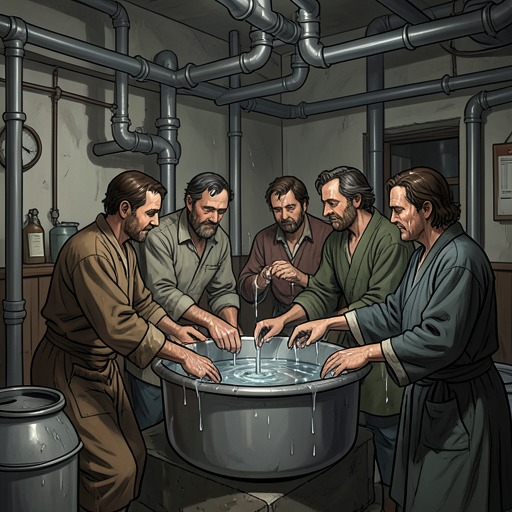
Water brotherhood
Stranger in a Strange LandWater brotherhood is a relationship established through sharing water, but its meaning reaches far beyond the drink itself: it makes participants kin, binds them to trust and mutual support, and can culminate in lasting membership in a communal Nest. Across the novel, the bond is offered and accepted by people with different degrees of understanding, so the rite becomes both an intimate declaration and a practical structure for forming a community.
Bond and obligations
For Valentine Michael Smith, water brotherhood is not a casual gesture. When he realizes that Anne, Larry, Miriam, and Dorcas are already water brothers of Jubal Harshaw, he understands that their kinship also makes them his brothers. The discovery comes through empathic recognition rather than explanation; it shakes him, and he deliberately steadies himself to appreciate the people whose relationship to Jubal he had not previously understood. He also senses Jill’s unrelieved distress and wants to share it, showing that the bond’s significance is inseparable from attention to another person’s feelings and needs.
Jubal explains the practical seriousness of accepting water from Smith to Duke. The commitment means never lying to or deceiving Smith and standing by him, because Smith will do the same in return. Jubal speaks from experience: he accepted the bond before he fully understood it, and came to feel its responsibilities more deeply as he learned what it meant. Duke, after considering the commitment, recognizes his own desire to care for Smith and accepts that this relationship will ask more of him than simple friendliness.
Smith applies the bond without waiting for others to master its language or customs. Having learned that Dorcas is his water brother, he tells Jubal that he has not kissed her; the remark makes clear that he understands the relationship as defining how people are connected, not as a label added after the fact. Later, when Ben Caxton has recovered from his ordeal, Smith learns through Jill that Ben and Jill are water brothers and solemnly offers water to Ben. Ben accepts after considering how his own earlier choices have already tied his future to Smith. His acceptance also follows an honest reckoning with jealousy over Smith and Jill’s closeness, which he decides he must overcome.
Ceremony and welcome
The rite can bridge differences in language and background. At a gathering with Smith and his companions, Mahmoud initially sees the group through his own distrust of American customs and his expectation that the meeting should be all male. Smith, however, presents the people around him as water brothers and thereby places a profound family obligation before Mahmoud. Mahmoud understands the Martian social meaning from experience: this is a kinship he regards as more binding than ordinary extended family ties, grounded in the exceptional value Martians place on personal relationships.
Jill cannot answer Mahmoud in Martian, so she turns to a pitcher and glass placed around the meeting table. She fills the glass, offers it to him, and makes the welcome plain through the act of sharing. Mahmoud responds with the principle that sharing water means sharing everything, then offers the glass onward. When Jill asks whether he understands the seriousness of the commitment, he confirms that he understands its fullness. Her blessing for their shared Nest moves her to tears; Miriam follows by welcoming him as a brother and passing the glass on. The exchange shows how the physical act can carry a commitment even when words fail, while the participants’ responses make the welcome mutual rather than merely ceremonial.
The rite also brings Smith’s relationship with Patricia Paiwonski into focus. Jill explains that sharing water resembles both baptism and marriage, but is a permanent partnership marked by trust and the freedom to speak openly. She and Smith warn Patricia not to accept if doing so would conflict with her religion or conscience; Patricia chooses to take part. Jill drinks first and passes the glass to Smith, who thanks Patricia and offers her the water of life. Her decision makes her part of their family by consent, not by assumption, and the ceremony gives her an enduring relationship with Smith and Jill.
From personal bond to community
Water brotherhood operates alongside the church’s training circles, but the two do not follow a single rigid sequence. Mike can recognize that someone is ready to share water before that person has reached the later circles: Sam and Ruth, for example, receive the offer when they have only just entered the Third Circle, and later become priest and priestess. Dawn and Patricia can occasionally identify candidates for special promotion and training, though the account emphasizes Mike’s distinctive capacity to judge readiness. Progress through the circles therefore involves both structured learning and personal discernment.
Patricia describes the movement from circle training to incorporation into the Nest. The Eighth Circle begins a phase of sharing and growing closer; eventually, the Ninth Circle leads to the Nest’s communal Sharing-Water service. The whole Nest attends, and new brothers—often a couple—become part of the community. Although Ben is already regarded as belonging, the community sets aside its other plans to hold the service that formally welcomes him. The distinction between everyday water-sharing and the named communal service matters: the ceremony publicly marks a transition that informal affiliation alone has not yet completed.
The Innermost Temple provides a dedicated setting for that transition. When Ben visits the Nest, Patricia shows him its large, circular room, with a central pool, and explains that new brothers are received there. She offers him the choice to share water or simply swim, and accepts his decision to wait. Her response treats readiness as part of the process rather than something to be forced. The account of Sam and Ruth’s initiation makes that patience consequential: they advance through the circles while learning Martian and developing the discipline required to participate, then receive water from Mike and Jill after Mike senses that they have begun to think in the language. Ruth recalls both her fear of entering the Nest and the help she received from the community; at the ceremony, she enters the pool and describes herself as never having come out of it. The image presents incorporation as a chosen passage into shared life, supported by the group rather than achieved alone.
Institutions and legacy
The novel sets this model of kinship beside the organization of the Church of the New Revelation. Its history includes an outer church for seekers, a larger middle church whose members are saved and participate in the movement’s public life, and an inner body of dedicated leaders who control records, policy, and the church’s mysteries. The contrast is not that the church has no organization or hierarchy: the Church of All Worlds also has circles, teachers, priests, and rites. Rather, water brotherhood makes personal obligation and communal welcome central to its religious structure, while the account of the New Revelation emphasizes graded access, institutional leadership, and carefully selected inner membership.
The community’s response to persecution demonstrates the practical value of a structure that can be re-established in new forms. Sam describes the Church of All Worlds closing and congregations being opened under other names when opposition drives them out. Each effort leaves behind a disciplined core and people who may later rejoin. He traces that growth from Mike’s early work with only three untrained priestesses to a solid Nest and a larger group of advanced pilgrims. Water brotherhood is not itself a guarantee against external hostility, but the bonds and shared discipline it creates help members remain connected as their public institutions change. Its movement from a glass of water between individuals to an initiated, enduring Nest thus gives the novel a concrete image of how trust can become a resilient social order.